Skip to content

Abrazo House

Home » Blog » Tyred but Happy

Tyred but Happy

Building a tyre retaining wall for our parking area, with some thoughts on problems and solutions

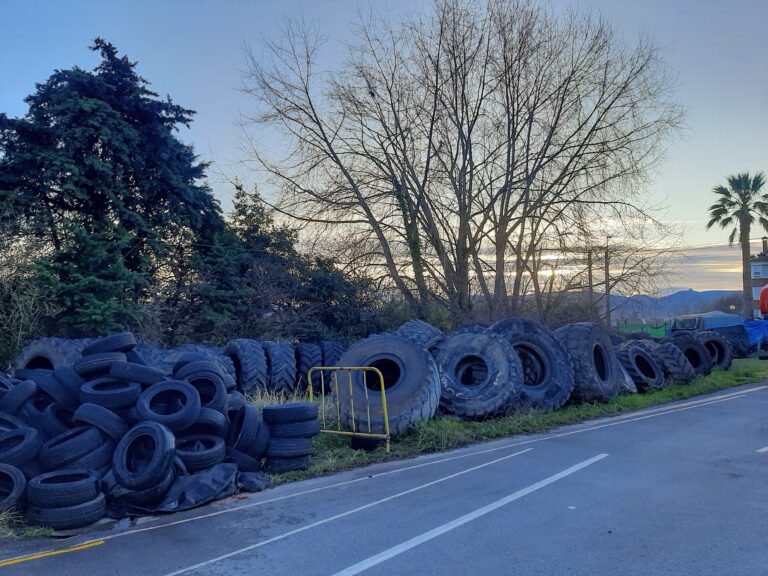
We humans spend large amounts of our time zipping around in metal boxes with rubber tyres (or tires, if you’re in the US.) These tyres quickly wear away—tyre dust is an important source of microplastics—and have to be replaced. Globally, every year a billion tyres reach the end of their useful life and have to be disposed of. Some are recycled (50% in the EU), some are incinerated, but many just pile up in heaps. One estimate is that 4 billion tyres are currently sitting in landfills and stockpiles around the world. They shed further microplastics into the environment, fill with water when it rains, and when it’s warm, become mosquito breeding grounds; and they never go away.

A beautiful sunset, with some not so lovely used tyres.
A lovely sunset with some not-so-lovely waste tyres.

The tyre problem was brought back to my attention recently when a volunteer who’s staying at our place—Abrazo House, an ecological learning centre in a tiny village in the green mountains of northern Spain—brought a dozen used car tyres home with the idea of using them as planters.
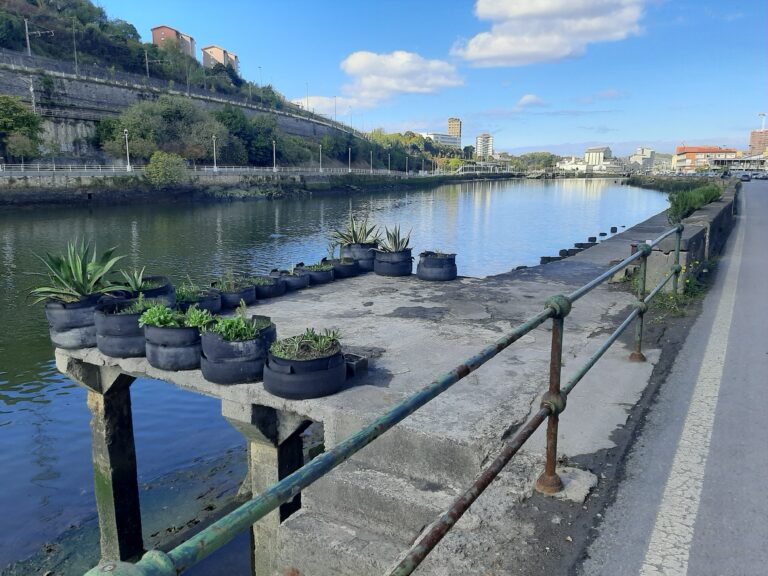
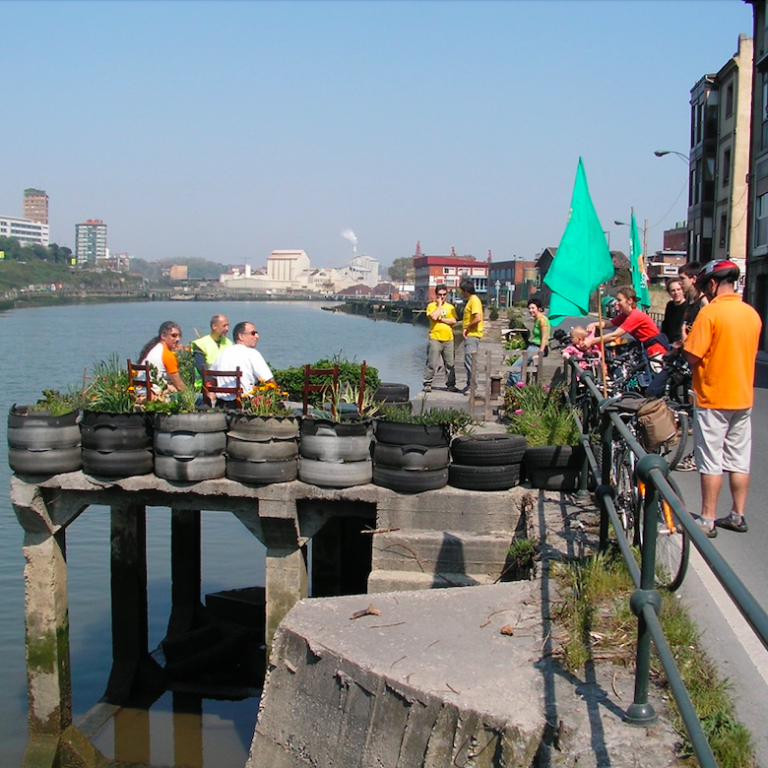
Initally, I wasn’t very happy with this. Back at the start of the Abrazo House project, almost twenty years ago, we did make quite a few projects with used tyres, including a riverside tyre garden in our old neighbourhood in Bilbao, built in September 2005, which was featured in Permaculture Magazine. The tyre garden is still in use twenty years on: partly a tribute to the design, but mostly to the fact that tyres are basically indestructible.

Riverside garden in Bilbao made of used tyres.
Our riverside tyre garden in 2006, shortly after construction.
The same garden in October 2025, twenty years on.

When we moved to the country, we continued to make things from used tyres: planters, tree guards, edging for raised beds, and even an ill-fated experimental roof covering. Ultimately, though, we concluded that they were awkward to work with, unsightly, potentially toxic, and unsuited to our new rural environment. So we decided to—as it were—curb our use of used tyres. But now, like the monster in a horror movie sequel, they were back!


Luckily, though, our tyre problem did turn out to contain a solution.


Abrazo House is located on a moderately steep (1-in-5) east-facing slope, which means we’ve had to build a number of terraces with retaining walls. Typically this would be done either by pouring a concrete wall—expensive, hideous and very high-impact—or with huge blocks of quarried stone, which is also expensive and high-impact, but at least looks good.


Recently we’ve seen the need to improve our parking area, meaning we needed another retaining wall, but we baulked at the cost and impact involved in building one. Then a friend bought a mini digger and offered to do a few days’ work for us at a reasonable rate.


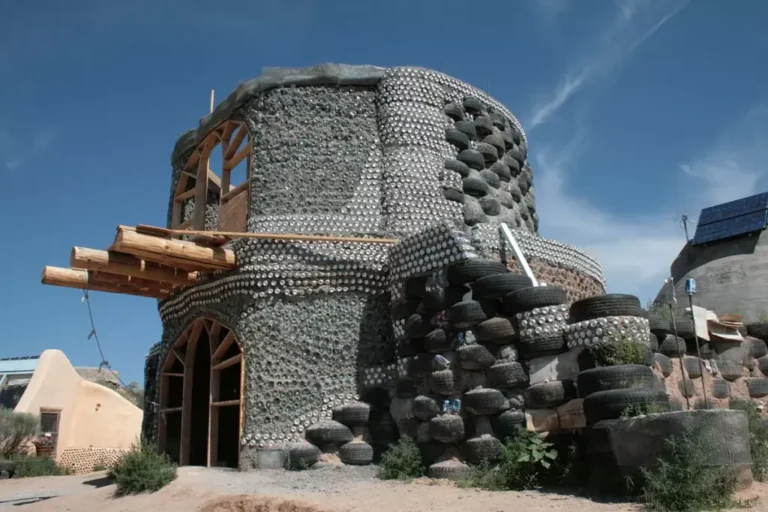
I’d known about tyre retaining walls for ages, ever since reading about Earthships, the earth-sheltered, rammed-tyre-wall houses designed by Mike Reynolds for the New Mexico desert in the 1970s (and later imported wholesale to disparate places from South East Asia to Brighton.) I’d seen photos of bronzed young men packing tyres with earth, using shovels, barrows and sledgehammers, and thought: who needs that amoung of sheer physical work? And who needs a house with tyres, and their potential toxic offgassing, included in the structure?
An unfinished Earthship in Australia. Source: Architecture Republic

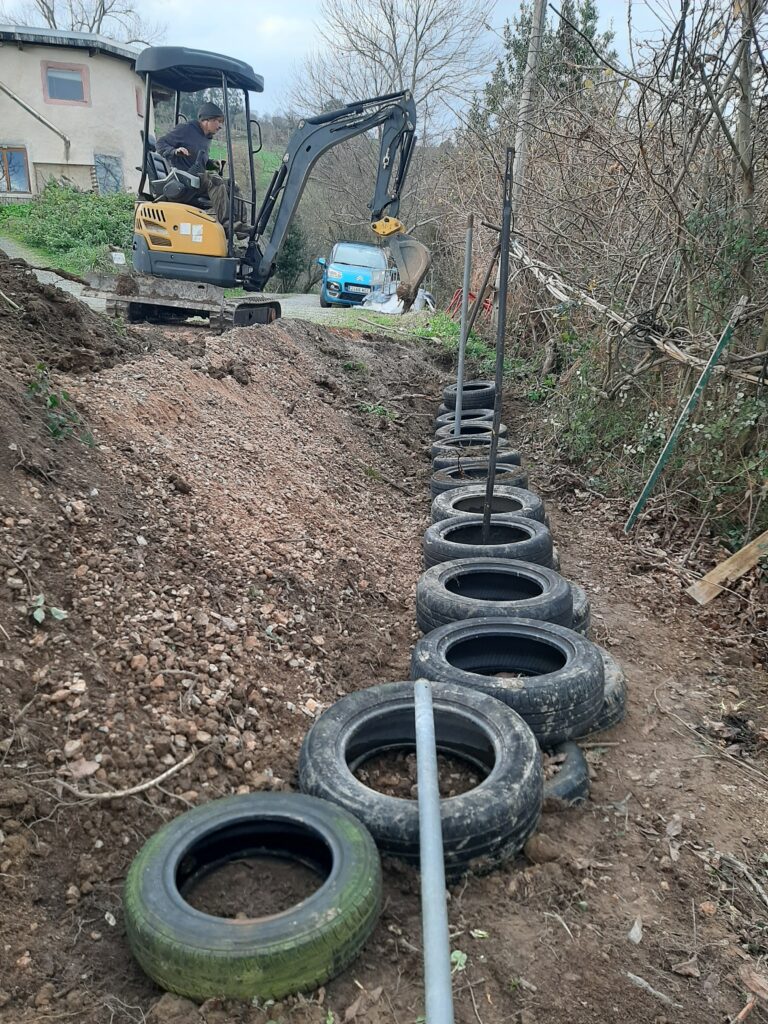
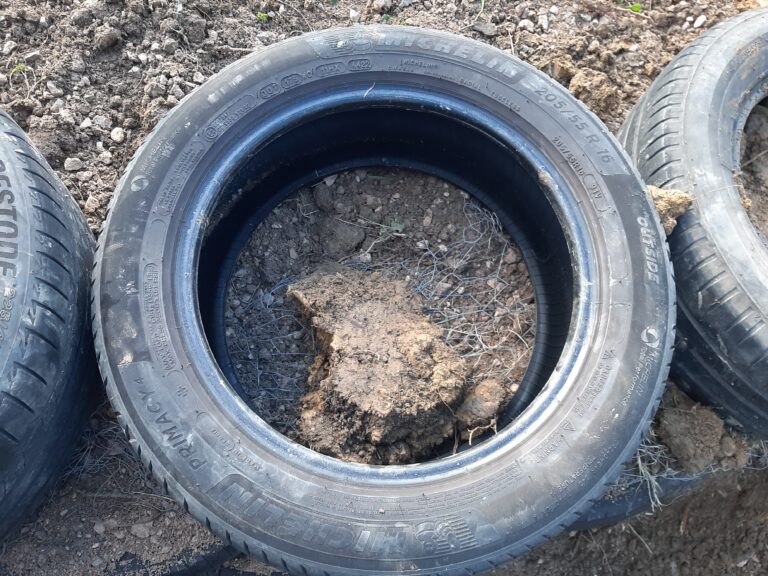
But having the tyres and the mini digger to hand, building a tyre retaining wall for the parking area seemed to be worth a try. It turned out to be, not exactly easy, but much less arduous than I’d feared.  The material we had to hand, a mix of clay soil and gravel, turned out to be great for compacting— basically the same mix as the cob we’ve built our houses from.

Filling the first full row of tyres in the retaining wall.

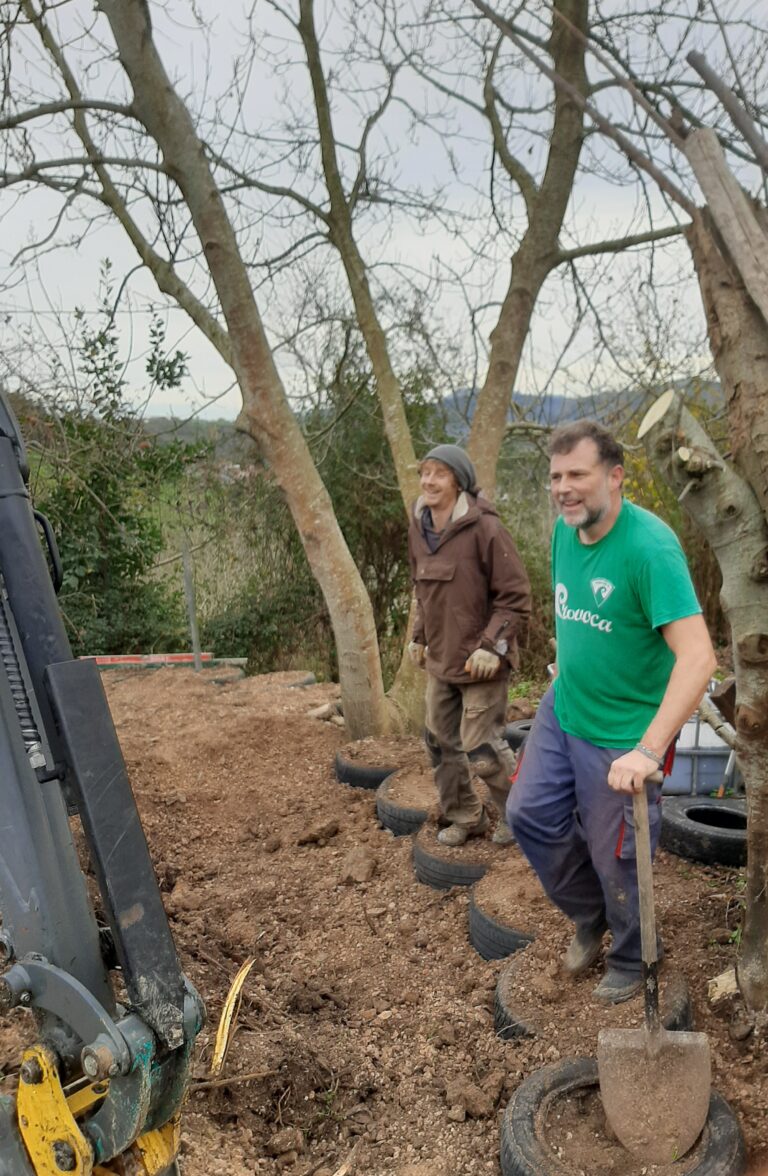
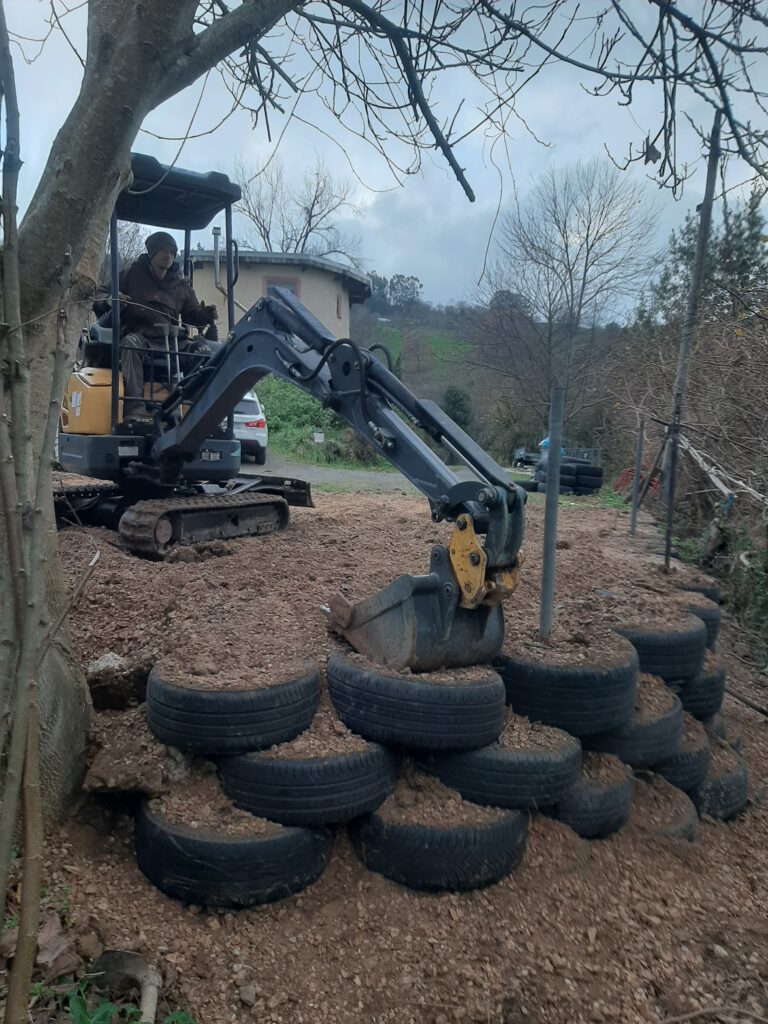
At Abrazo House we’ve always worked mainly with volunteers. As a result, I suppose we’ve become somewhat experienced in finding ways of working that are suited to a workforce that isn’t getting paid. We tend to do things with simple tools and simple procedures that give you a good workout but aren’t too taxing on the body—a consideration that weighs more heavily on me with each passing year. Applying this practice to the tyre wall, it seemed that the best way to fill and compact the tyres was using your boots, in a sort of heel-and-toe dance, to kick the material into the rim, with the digger doing the main work of shovelling and tamping.  No sledgehammer required!
The easiest tyres to fill, naturally, were those with very little rim. Later I read some reports saying that the upper sidewall can be removed with an electric saw, without impacting the stability of the wall—which would perhaps save work, though it’s a lot of cutting.

Doing the tyre dance.

As the wall went up, we added some metal poles to tie the layers together. The poles stick up above the level of the wall, which will help to stop people accidentally driving off the edge, and we can later use them to train kiwi vines. The tyres are laid in a running bond like bricks, stepping back slightly at each layer, and with the holes (at the overlap between the tyres on the level below) stuffed with whatever came to hand, from rocks to bits of chicken wire.

Plugging the gap in the row below with chicken wire and a lump of clay.

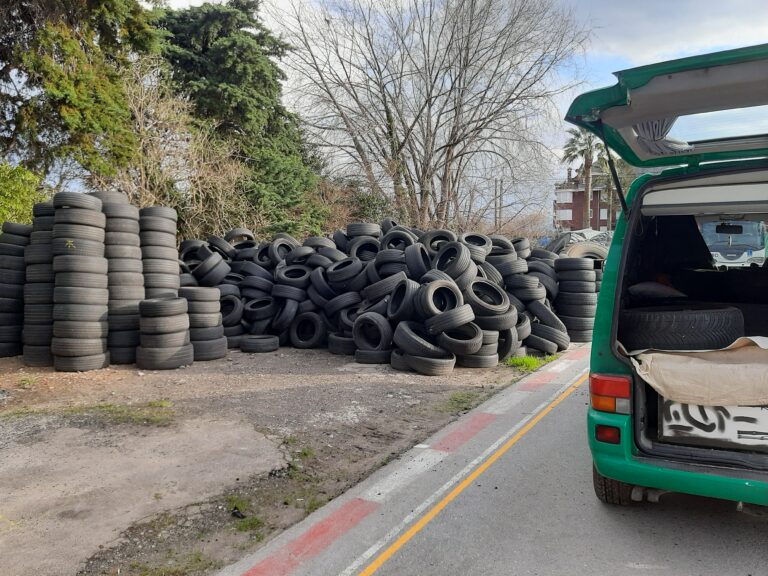
We quickly used up the tyres that were to hand and had to go and get more from a local workshop. They were only too happy to let us into to their back lot, where I guesstimate between five and ten thousand tyres were heaped up. This, of course, isn’t a landfill (banned in the EU) but a temporary stockpile. Each tyre contained a few liters of stagnant water, which had to be tossed out by throwing the tyres around a bit before loading them into the van. I’m very glad I don’t live in the adjacent flats once mosquito season starts.

Picking up some tyres from our local tyre stockpile / mosquito breeding ground.

Three days of work with the digger, four more vanloads of tyres—around 150 in all—and the wall was complete. My legs felt like I had spent the weekend at a Cossack dancing festival, but I was very happy with the finished product. And what better place that a parking lot—where nearly everyone arrives on the site in a wheeled vehicle of some kind—to bring people’s attention to the problem of waste tyres?

Tamping a tyre in the final row.

There’s certainly a lot of potential, especially in mountainous areas like ours, for waste tyres to be  turned into retaining walls. Probably there will be a fair amount of resistance, too—nobody likes to see waste piling up around them; they prefer it out of sight and out of mind. But problems can only become solutions when they’re made visible. If they’re hidden away out of sight—which unfortunately is our civilisation’s typical approach—they only fester and grow worse. That, for me, is the take-home message of our tyre wall: Don’t let your problems pile up in a back lot; invite them into the open, and you might find they become solutions.

Leave a Reply

Your email address will not be published. Required fields are marked *

EN_GB